

The 3D Mirage of Master System Innovation
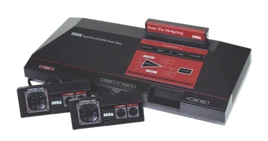
Space Harrier 3D (Japan) stands as one of the most ambitious experiments ever released on the Master System / Mark III hardware, blending arcade spectacle with early stereoscopic technology in a way few 8-bit titles ever attempted. Developed and published by , this 1988 release reimagined the legendary arcade shooter Space Harrier through a proprietary 3D glasses system, aiming to bring true depth perception to home consoles long before modern VR or shader-based depth effects existed. The result is a surreal, high-speed tunnel shooter that feels less like a traditional port and more like a technological statement piece—an artifact of Sega’s obsession with pushing perception itself as a gameplay mechanic.
Unlike standard Master System releases, this version demanded the use of active shutter-style 3D glasses, synchronized with alternating frame output. That hardware constraint alone makes it one of the most distinctive experiences in the console’s library. It wasn’t just a game—it was a glimpse into Sega’s experimental DNA, where arcade spectacle was reinterpreted through consumer hardware limitations.
Into the Depths: Space Harrier 3D (Japan) and the Illusion of Speed
Arcade DNA Rebuilt for the Living Room
The core gameplay of Space Harrier 3D (Japan) retains the essence of the original arcade hit: a fast-moving third-person shooter where the player glides forward through surreal landscapes, blasting waves of enemies while dodging environmental hazards. The “3D” layer, however, transforms everything. Sprites are rendered alternately per eye, creating a rudimentary but effective depth illusion that makes enemy dragons, floating pillars, and alien structures feel like they are physically emerging from the screen.
Movement is restricted to a single plane, but the illusion of depth compensates by making spatial awareness a core survival skill. Enemies don’t just approach—they “occupy space,” forcing players to mentally track layers of motion rather than flat trajectories. This introduces a unique cognitive load rarely seen in 8-bit shooters, where reaction time and spatial prediction must operate simultaneously.
High-Speed Design and Brutal Precision
Stage design escalates rapidly, with enemy formations becoming denser and more erratic as the game progresses. Unlike many Master System shooters, collision detection here feels deliberately unforgiving, emphasizing arcade-style memorization over casual reaction. The lack of slowdown means sprite flickering becomes part of the experience, especially when multiple enemies and projectiles overlap in tight formations.
- Fast-forward forced scrolling increases pressure on player reflexes
- Enemy waves follow semi-randomized spawn arcs
- Boss encounters rely heavily on pattern recognition under visual distortion
Mastering the Chaos: Reflex Meets Perception
The defining challenge is not just aiming or dodging—it’s interpreting depth correctly under hardware-driven optical illusions. The 3D effect can occasionally distort enemy positioning, making certain attacks appear closer or farther than they actually are. Skilled players learn to “ignore” the illusion at critical moments, relying instead on muscle memory and audio cues.
Technical Ambition Beyond Its Time
From a design standpoint, the game represents one of the earliest consumer attempts at stereoscopic gameplay outside of dedicated arcade cabinets. Frame alternation introduces subtle input latency variations depending on display hardware, and CRT synchronization is essential for the intended effect. On poorly calibrated displays, the illusion collapses entirely, turning the game into a visually chaotic but still mechanically functional shooter.
Audio Design and Sensory Overload
The soundtrack retains Yu Suzuki’s arcade-inspired intensity, with driving synth lines that reinforce the sensation of forward momentum. Sound effects are intentionally sharp and compressed, ensuring they cut through the visual noise. Combined with the 3D effect, the result is a sensory overload loop where sound becomes an anchor for visual disorientation.
Hardware Illusion Engineering in Space Harrier 3D (Japan)
How Sega Bent the Master System
The Master System was never designed for stereoscopic output, yet Sega engineered a workaround using alternating frame rendering and synchronized shutter glasses. This required precise timing between video output and lens switching, effectively doubling rendering demands on the system’s video hardware. The result is a pseudo-3D environment built entirely from 2D sprite layers.
Sprite handling is particularly impressive: background layers are carefully offset between frames to enhance depth perception, while enemy sprites are duplicated with slight positional variance to simulate parallax. However, this comes at the cost of increased sprite flickering in heavy combat scenarios.
Frame Buffer Constraints and Visual Artifacts
The lack of a true frame buffer for stereoscopic rendering leads to occasional desynchronization artifacts. When played on inaccurate emulation cores or modern displays without proper timing correction, the 3D effect may appear doubled or inverted. These issues are not bugs per se, but intrinsic limitations of how the system fakes depth.
Audio-Visual Synchronization
The game’s sound engine remains stable even under heavy sprite load, which helps maintain player orientation. Unlike many contemporaries, audio is not downgraded during performance stress, ensuring consistent feedback during high-intensity sections.
Emulation, Preservation, and Modern Play
Today, playing Space Harrier 3D (Japan) requires emulation or original hardware with 3D glasses support. The most accurate experience is achieved through Master System cores such as Genesis Plus GX in RetroArch, which includes support for stereoscopic toggles and frame pacing adjustments.
- Best emulator setup: RetroArch + Genesis Plus GX core
- Enable: 3D glasses emulation mode
- Recommended setting: Integer scaling off, CRT shader optional
- Audio latency: Keep low (under 64ms) for rhythm consistency
On handheld devices like the Steam Deck or Android-based systems such as Odin, the game runs flawlessly at high internal resolutions. When upscaled to 4K, sprite edges become sharper, but the original dithering patterns remain visible, preserving the retro aesthetic. Interestingly, high-resolution scaling can sometimes reduce the perceived strength of the 3D effect, as pixel alignment becomes too clean to support the illusion effectively.
Common emulation issues include desynced stereoscopic output and incorrect frame pacing, both of which can be fixed by enabling accurate VBlank timing and disabling runahead features. Save states work reliably, though they can occasionally disrupt 3D synchronization if loaded mid-frame.
Legacy of an Optical Experiment
While not as widely known as its arcade counterpart, Space Harrier 3D remains a cult favorite among collectors and hardware historians. It represents a rare moment when console gaming attempted true stereoscopic depth without modern GPU assistance. Its influence can be traced through later experimental titles and even early VR prototypes that pursued similar ideas of forward motion immersion.
Although no direct sequels retained the same 3D hardware approach, the concept of high-speed tunnel shooting evolved into later Sega experiments and spiritual successors in arcade design philosophy. Within emulation communities, it is often revisited not for competitive play but for historical appreciation of early 3D ambition.
Speedrunning interest remains niche but passionate, focusing on optimized routes through enemy patterns rather than pure completion time. The game’s randomness and visual distortion make it an unusual but fascinating candidate for mastery.
FAQ: Space Harrier 3D (Japan) Technical and Gameplay Questions
How do I fix glitchy 3D visuals in emulation?
Ensure you are using Genesis Plus GX with stereoscopic mode enabled. Disable runahead and force accurate VBlank timing to stabilize frame alternation.
What is the best way to experience the original 3D effect?
Original hardware with Sega 3D glasses and a CRT display provides the most authentic experience, preserving the intended depth illusion and timing synchronization.
Why does the screen flicker during gameplay?
This is caused by alternating frame rendering for stereoscopic output. It is not a bug but a core part of how the 3D illusion is generated.
Does the 3D effect work in modern HD upscaling?
Yes, but the effect can feel less pronounced at higher resolutions due to reduced pixel-based depth ambiguity. CRT shaders can help restore the intended feel.


