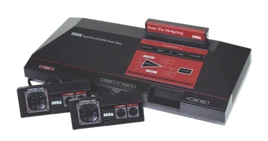


Master of Darkness (Europe, Brazil) (En): Sega’s Gothic Answer to Castlevania on the Master System
Master of Darkness (Europe, Brazil) (En) arrived in the early 1990s as one of the most ambitious late-cycle releases for the Sega Master System Mark III, developed by SIMS and published by Sega. Often overshadowed by its 16-bit contemporaries, this gothic action-platformer quietly carved out a reputation as one of the system’s most technically and artistically impressive titles. Built in the shadow of Konami’s Castlevania series, it nevertheless established its own identity through moody Victorian aesthetics, tight combat design, and surprisingly advanced presentation for 8-bit hardware.
Set in a fog-drenched London haunted by occult experiments and serial killings, the game positions players as a detective armed with blades, pistols, and sheer persistence. What follows is a methodical descent through horror-themed stages that feel unusually cinematic for the Master System’s limitations, pushing sprite handling, animation layering, and atmospheric sound design far beyond what most players expected from the platform.
Victorian Horror Reimagined: The World of Master of Darkness (Europe, Brazil) (En)
Released in 1992 in Europe and Brazil, the game arrived when the Master System was already being eclipsed by the Mega Drive, yet it demonstrated Sega’s continued commitment to its 8-bit audience. SIMS, a studio known for adapting arcade-style responsiveness into console-friendly formats, built a game that fused platforming precision with deliberate combat pacing.
A Darker Kind of Platformer
- Setting: Victorian London infused with supernatural experimentation and occult horror.
- Structure: Linear stage progression with branching enemy encounters and mini-bosses.
- Weapon System: Melee knife attacks combined with limited-use firearms.
- Health Model: Traditional life bar with item-based recovery, encouraging careful exploration.
Unlike faster arcade-style platformers of the era, this game leans into tension. Enemy placement is deliberate, often punishing over-aggression while rewarding patience and memorization.
Blade, Bullet, and Precision: Gameplay of Master of Darkness (Europe, Brazil) (En)
The core gameplay loop revolves around timing and spatial awareness. Players must alternate between close-range knife attacks and ranged pistol shots depending on enemy type and positioning. This dual-combat system adds strategic depth rarely seen in Master System titles.
Combat Flow and Enemy Design
Enemies are designed with clear behavioral patterns, but their placement often forces quick adaptation. Zombies shamble slowly, but airborne enemies and fast-moving bosses introduce pressure spikes that break rhythm. Hitboxes are intentionally strict, giving combat a weighty, almost survival-horror feel despite the side-scrolling format.
Platforming sections are equally demanding. Precision jumps are often layered with enemy threats, forcing players to commit to movement rather than hesitating mid-air. The game’s pacing is deliberately methodical, rewarding observation over reaction speed.
Technical Brilliance in 8-Bit Darkness
From a technical standpoint, Master of Darkness pushes the Sega Master System Mark III close to its upper limits. The game uses detailed background layering to simulate depth, with parallax-style scrolling achieved through careful sprite manipulation. This creates an illusion of cinematic environments rarely seen on the hardware.
Sprite flickering is present in high-density enemy encounters, but SIMS mitigates it through controlled spawning logic and reduced on-screen clutter during boss fights. Animation frames for enemies and the protagonist are unusually smooth for the platform, contributing to a sense of weight and physicality.
Audio design also plays a crucial role. The soundtrack relies on minor-key melodies and slow-paced rhythms, reinforcing the gothic tone. Sound effects—particularly weapon swings and enemy hits—are crisp, giving feedback that enhances combat timing despite the console’s limited PSG sound chip.
Playing Master of Darkness (Europe, Brazil) (En) Today: Emulation and Enhancements
Modern players looking to experience Master of Darkness (Europe, Brazil) (En) have several reliable emulation options, each offering different trade-offs between accuracy and visual enhancement. Because the game was designed around CRT displays, timing and scaling can significantly affect gameplay feel.
Best Emulation Setups
- RetroArch (Genesis Plus GX core): Most accurate Master System timing and sprite rendering.
- Kega Fusion: Lightweight and stable, with consistent input handling.
- Shaders: CRT-Geom or Slot Mask shaders recommended to preserve original scanline timing.
Common Issues and Fixes
- Input Lag: Enable run-ahead frames in RetroArch to reduce delay in combat-heavy sections.
- Sprite Misalignment: Use integer scaling (3x or 4x) to avoid distortion in platforming jumps.
- Audio Desync: Switch audio backend to WASAPI or low-latency ALSA depending on platform.
On handheld devices like the Steam Deck or Ayn Odin, the game performs exceptionally well due to stable frame pacing. When upscaled to 4K, the gothic pixel art becomes strikingly detailed, with background textures revealing subtle architectural elements that were previously obscured on CRT displays. However, without shader support, the image can appear overly sharp, reducing its atmospheric haze.
Legacy of Master of Darkness (Europe, Brazil) (En)
Although it never reached the mainstream recognition of Castlevania, Master of Darkness has earned a cult following among Master System enthusiasts. It is frequently cited as one of the system’s most mature and visually ambitious titles, often serving as a benchmark for what late-era 8-bit design could achieve.
Its influence can be seen in later gothic-inspired indie platformers, and it remains a popular candidate for retro challenge runs and no-damage completions within emulation communities. While it never received direct sequels, its design philosophy—methodical combat, atmospheric storytelling, and restrained pacing—echoes through later Sega action titles.
Frequently Asked Questions
What is the best way to play Master of Darkness (Europe, Brazil) (En) today?
The most authentic experience comes from RetroArch using the Genesis Plus GX core with CRT shaders enabled. This combination preserves original timing while improving visual clarity on modern displays.
Does Master of Darkness (Europe, Brazil) (En) suffer from slowdown or sprite flickering?
Yes, occasional sprite flickering occurs during heavy enemy scenes due to Master System hardware limits. However, it is generally well-managed compared to other games of the era.
Is Master of Darkness a Castlevania clone?
It is heavily inspired by Castlevania, but it introduces its own combat pacing, firearm mechanics, and detective-themed narrative that differentiate it significantly from Konami’s series.
Can I play Master of Darkness (Europe, Brazil) (En) on modern handhelds?
Yes. Devices like the Steam Deck and Ayn Odin run Master System emulation flawlessly, and with proper shader configuration, the game retains its intended gothic atmosphere.


