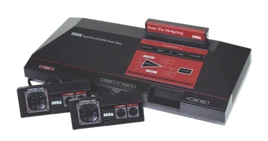


When Light Phaser Met Arcade Ambition: The Story Behind Assault City (Europe) (Joypad)
Assault City (Europe) (Joypad) stands as one of the more unusual entries in the Master System library, not only for its futuristic arcade styling but also for its strong association with the Light Phaser peripheral. Developed and published by Sega in 1990, this rail-shooter arrived during a transitional era where home consoles were beginning to experiment more boldly with arcade-style immersion. Unlike traditional run-and-gun titles of the time, Assault City attempted to bring a controlled, cinematic shooting gallery experience into the living room, complete with digitized targets, pseudo-3D corridors, and rapid reflex gameplay built around precision aiming rather than platforming.
While it never achieved the mainstream recognition of other Sega classics, Assault City has become a fascinating preservation piece for retro enthusiasts. It captures a moment where hardware limitations, experimental design, and accessory-driven gameplay collided in a way that feels both ambitious and slightly unrefined today.
Neon Streets and Laser Fire: Assault City (Europe) (Joypad) Under Pressure
At its core, Assault City is a first-person rail shooter where players are locked into a forward-moving perspective, tasked with eliminating waves of robotic enemies and criminal threats across a dystopian cityscape. The Joypad version is particularly notable because it supports traditional controller input, but the experience was originally designed with the Light Phaser in mind, making aiming speed and accuracy central to the gameplay loop.
On-Rails Intensity and Target Discipline
The game doesn’t allow free movement. Instead, the camera advances automatically through city streets, industrial corridors, and enemy bases. Players must react quickly to on-screen threats, which appear in scripted patterns. This design creates a tension similar to arcade cabinets like Space Harrier, but with tighter, more claustrophobic pacing.
- Fixed forward movement with branching enemy attack waves
- Precision-based shooting mechanics
- Limited reaction windows for high-pressure encounters
- Occasional boss sequences requiring pattern memorization
The difficulty curve is unforgiving. Enemy projectiles often arrive with minimal telegraphing, forcing players to rely on memory and reflex rather than reaction alone. This gives Assault City a distinct arcade DNA that feels intentionally punishing.
Level Design Built on Reflex Memory
Rather than offering expansive exploration, Assault City structures its stages as sequential combat corridors. Each segment introduces new enemy behaviors—hover drones, armored turrets, and fast-moving ground units—before layering them into mixed encounters. This escalation system compensates for hardware constraints by reusing environments while increasing complexity through enemy density and speed.
Pixel Warfare and Hardware Limits: The Technical Side of Assault City (Europe) (Joypad)
On the Master System Mark III hardware, Assault City pushes sprite handling and background layering to its practical limits. The game frequently exhibits sprite flickering during heavy combat sequences, a common artifact when too many objects are rendered simultaneously. However, the developers cleverly mitigate this through enemy spacing and careful pacing of attack waves.
The soundtrack uses FM-style chiptune composition techniques that emphasize urgency. Sharp electronic stingers accompany enemy spawns, while bass-heavy loops create tension during extended firefights. Sound design plays a crucial role in compensating for relatively simple visuals.
One of the more interesting technical aspects is how the game simulates depth. Enemies scale slightly as they approach the player’s viewpoint, creating a rudimentary illusion of 3D space. While primitive by modern standards, this effect was highly effective for its time and contributed to the arcade-like immersion Sega was clearly aiming for.
Playing Assault City (Europe) (Joypad) Today: Emulation and Modern Enhancements
Modern players can experience Assault City through several Master System emulation options, each offering different levels of accuracy and enhancement. The most reliable cores include Genesis Plus GX via RetroArch and standalone emulators like Kega Fusion. These provide near-cycle-accurate rendering of Light Phaser timing and sprite behavior.
Recommended Emulator Settings
- Core: Genesis Plus GX (RetroArch)
- Video Driver: Vulkan (for best performance scaling)
- Integer scaling: ON for pixel accuracy
- Run-ahead: 1 frame (optional, reduces input lag)
- CRT shaders: optional for authentic scanline feel
On handheld devices such as the Steam Deck or Android-based systems like the Odin, Assault City runs effortlessly, but control mapping becomes crucial. Mapping light gun input to analog sticks or gyro aiming significantly improves playability. Without this adjustment, the game’s precision requirements can feel unnecessarily harsh.
Upscaled to 4K, Assault City reveals both its charm and its limitations. Pixel art edges become cleaner, but sprite flickering becomes more noticeable unless frame blending or CRT filters are applied. Many enthusiasts prefer a soft scanline shader to preserve the original arcade atmosphere.
Common Emulation Issues and Fixes
- Input lag: Enable run-ahead or reduce buffer frames
- Light Phaser accuracy issues: Switch to mouse input mode
- Audio desync: Lock core timing to 60 FPS
Legacy of Assault City (Europe) (Joypad): Sega’s Forgotten Experiment
Today, Assault City is remembered less as a blockbuster and more as an experimental snapshot of Sega’s arcade philosophy translated to home hardware. It never spawned a major franchise or direct sequel, but it influenced later rail shooters that refined the formula with better hardware support.
In retro gaming communities, it is often discussed alongside other Light Phaser titles as part of Sega’s early attempt to establish peripheral-driven gameplay. While it lacks the polish of later shooters, its raw structure and difficulty make it appealing to speedrunners and preservationists who enjoy mastering tightly scripted arcade patterns.
There is also a small but dedicated emulation community that experiments with perfecting Light Phaser accuracy, aiming to recreate the original arcade-like responsiveness on modern displays. In this sense, Assault City continues to live on not as a mainstream classic, but as a technical curiosity that rewards deep system understanding.
FAQ: Assault City (Europe) (Joypad) Explained
Is Assault City playable without the Light Phaser?
Yes. The Joypad version supports standard controller input, but the game is noticeably more difficult and less precise compared to the Light Phaser experience it was originally designed for.
What is the best way to play Assault City today?
The most accurate experience comes from RetroArch using the Genesis Plus GX core with mouse emulation or light gun mapping. Steam Deck with gyro controls is also an excellent modern alternative.
Does Assault City have any sequels?
No direct sequels were released, but its mechanics influenced later Sega rail shooter design philosophies and similar arcade-inspired home conversions.
Why does the game flicker during gameplay?
Sprite flickering occurs due to hardware limitations of the Master System when too many objects are rendered simultaneously. This is authentic to the original hardware behavior.


